20 kHz · Digital
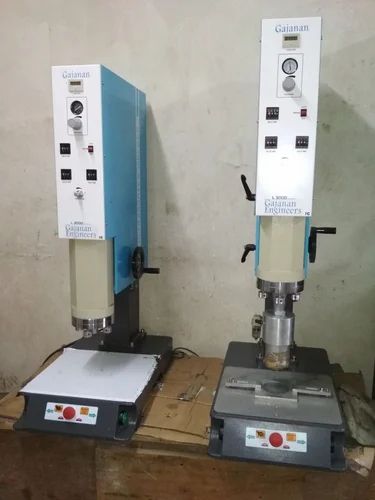
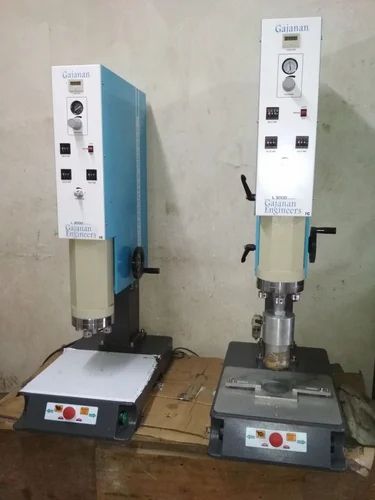
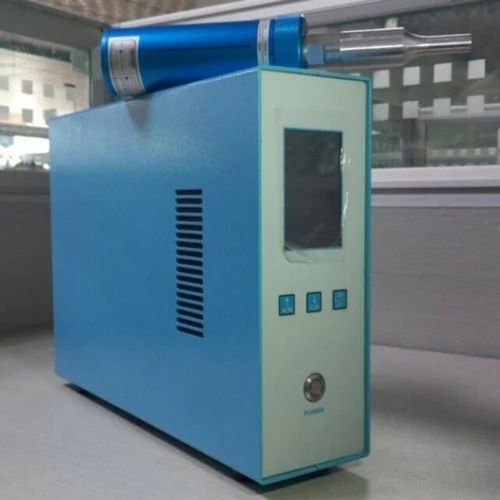
Ultrasonic Digital Plastic Welding Machine
₹2,00,000 / piece
ElectricAuto + Semi-autoMade in India
Manufacturer & Exporter Since 2013
Gajanan Engineers builds ultrasonic plastic welding machines, horns, boosters and generators in Gandhinagar, Gujarat — 15 kHz and 20 kHz, 1500 W to 4200 W, matched to your component and your cycle time.
In one paragraph
Gajanan Engineers is a sole-proprietorship engineering firm founded in 2013 at Gandhinagar, Gujarat, India, run by proprietor Jagrut Dave. We manufacture, supply and trade ultrasonic plastic welding machines and the full ultrasonic stack around them — generators, transducers, boosters, horns and fixtures — plus spin welding, hot plate welding, non-woven fabric sealing and hand-gun systems. Our catalogue runs from ₹25,000 single-purpose units to ₹3,50,000 high-power digital systems, all built for 220 V single-phase Indian shop-floor supply. We also take on ultrasonic welding job work, so you can prove the joint on your own part before buying a machine.
Year established
Products listed
Equipment categories
IndiaMART rating
IndiaMART member
Product range
Every machine on this list is built and stocked at Gandhinagar. Pick a family to see live specifications and prices.
Analog, digital and servo systems. 15/20 kHz, 1500 W–4200 W, round and square column.
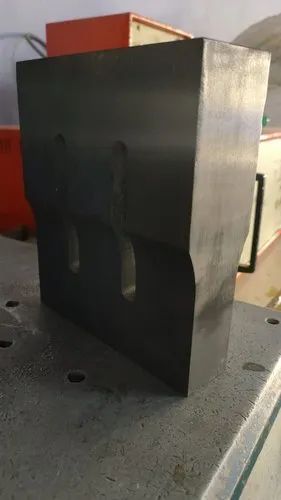
31 products 02Aluminium, titanium and alloy-steel sonotrodes cut to your part. Mask, C-type and multi-head horns.
8 products 03Analog and digital generators with power, energy, time and depth welding modes.
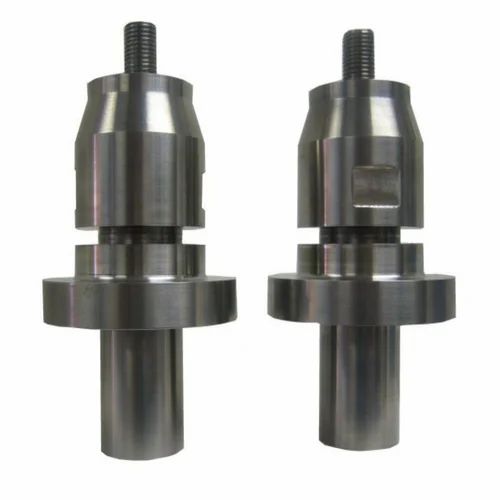
2 products 04Piezo converters and amplitude boosters as spares or as gain upgrades to an existing stack.
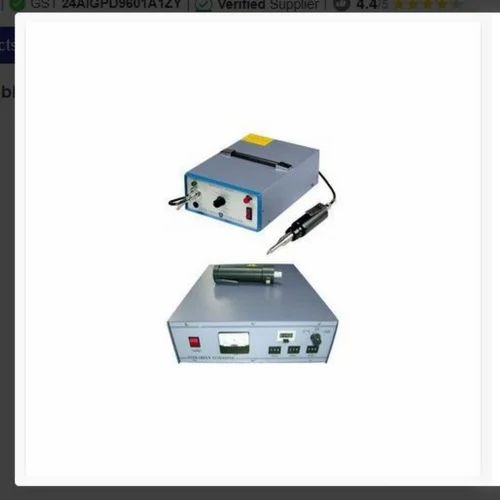
3 products 05Portable manual ultrasonic guns for spot welding, riveting and rework away from the bench.
3 products 06Rotary, servo-position and hot-plate machines for circular joints and large flat welds.
5 products 07Fabric sealers, scrubber machines, tube sealing and ear-loop welding for non-woven lines.
5 products 08Send your component. We weld a sample, prove the joint, then quote the right machine.
Talk to usBest sellers
Live prices from our catalogue. Every unit is configurable — frequency, wattage, automation grade and horn are matched to your part.
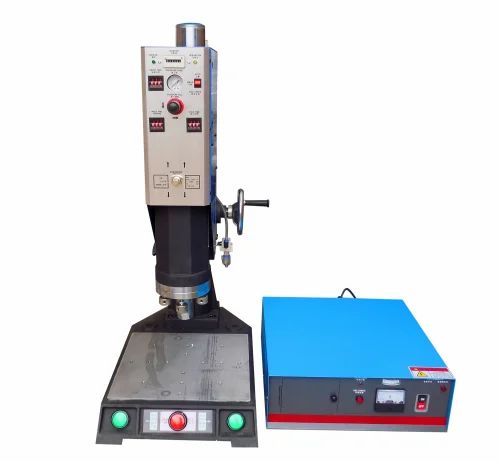
₹2,00,000 / piece
₹2,00,000 / piece
The technology
No adhesive, no fastener, no external heat. 230 V mains becomes 20 kHz vibration, vibration becomes friction, friction melts the joint — and the part is fused before you finish blinking.
The generator turns 220 V / 50 Hz mains into a high-frequency 15 kHz or 20 kHz electrical signal.
A piezoelectric transducer converts that signal into mechanical movement of roughly 20 micrometres.
The booster raises amplitude; the horn shapes and delivers it precisely into the joint area.
Interface friction melts the thermoplastic. Pressure holds, the melt solidifies, and the joint is as strong as the parent material.
Why buyers stay
Ten people, one proprietor who knows every machine on the floor, and no layer of sales between you and the engineer who will build your horn.
Machines, horns and fixtures are made in our own Gandhinagar workshop — not rebadged imports.
Standard configurations ship fast; custom horn work is quoted with a firm date, not a guess.
Our quality division runs the machine against market standards and on your sample part where supplied.
Aluminium, titanium and special alloy steel sonotrodes cut to your part geometry and joint design.
Supplied across India from Gandhinagar, with transparent dealing and no hidden freight surprises.
Prove the weld on your own component first. Buy the machine once you have seen the joint hold.
Applications
Materials welded: ABS, PP, PE, PC, PVC, Nylon and Acrylic — plus non-woven fabric sealing.
Questions we get daily
It joins thermoplastic parts with high-frequency vibration instead of glue, screws or external heat. A generator converts 230 V / 50 Hz mains into a 15 kHz or 20 kHz signal; a piezoelectric transducer turns that into mechanical vibration; a booster and horn amplify it and drive it into the joint. Friction at the interface melts the plastic and the parts fuse in roughly 0.2 to 1 second.
Our machines are supplied for ABS, PP, PE, PC, PVC, Nylon and Acrylic, and for non-woven fabric sealing. Amorphous plastics such as ABS, PC and acrylic weld most easily. Semi-crystalline materials such as PP, PE and Nylon are very weldable too, but they demand correct horn design and joint geometry — which is exactly why we cut horns to your part rather than selling a generic one.
20 kHz is the general-purpose choice for small and medium parts: electronic housings, mobile chargers, bottle caps, connectors, impellers. 15 kHz delivers higher amplitude over a larger welding area, so it suits big parts — automotive panels, toys, luggage, PP corrugated boxes, geocell and file folders. We build both, from 1500 W up to 4200 W.
Our listed prices run from about ₹25,000 for a single-purpose impeller welding unit to about ₹3,50,000 for a 20 kHz high-power system. Mid-range analog machines sit around ₹45,000–₹60,000; digital-generator and servo systems around ₹2,00,000–₹2,50,000. Final price depends on frequency, wattage, automation grade and the custom horn and fixture your part needs.
Yes — this is core work for us. Horns are cut in aluminium, titanium and special alloy steel to your part geometry, including non-woven mask horns, C-type mask horns, 150 mm non-woven horns and multi-head production horns. Boosters and transducers are supplied as spares or as amplitude upgrades to a stack you already own.
Yes. We list ultrasonic plastic welding job work alongside machine supply. Send your component, we weld a sample and you see the joint before spending on a machine. Message us on WhatsApp and we will tell you what to courier.
Our workshop is at Plot No. 15, Megh Dhanushya-1 Society, Dholeshwar Mahadev Road, Randesan, Gandhinagar 382007, Gujarat. We supply across India, dispatched from Gandhinagar. Buyers regularly visit the workshop to see a machine running before ordering — you are welcome to.
From the shop floor
Written by the person who cuts the horns. No sales copy — where the honest answer is that you need a different process, the guide says so.
Energy director dimensions, shear joint interference, wall thickness, and the flat-butt-joint mistake we see most.
Read the guideWhy a 15 kHz horn is bigger, when the extra amplitude matters, and why wattage is a separate question.
Read the guideWeak welds, marking, flash, diaphragming, cracked horns and overload trips — and how to tell them apart.
Read the guideNext step
A photo of your component and the joint you need is enough to start. Reply usually the same working day.